.jpg)
Which Pedestrian Entrance Control Solution Is Right For Your Project?
Whether you're securing a corporate headquarters, warehouse, transport hub or visitor attraction, Evolve offers a range of entrance control systems to suit every application. Compare our products below or speak to one of our specialists for tailored advice.
Product Selection Guide.
A product selection guide is crucial due to the diverse range of access control turnstile types available, each often referred to by different names from various manufacturers. Understanding the unique features and benefits of each type is essential, as making an incorrect choice can lead to inefficiencies, compromised security, or increased costs. This guide will help you navigate the options and make an informed decision for your specific needs.
The above information is provided by various manufactures, Evolve has meticulously optimised its product designs, ensuring robustness, safety, security, and reliability to created solutions that meet the highest standards.
Tripod turnstiles are durable pedestrian access control systems designed to regulate entry and exit using three rotating arms arranged in a triangular configuration. Each arm rotates through 120° to allow a single authorised person to pass, helping to prevent unauthorised access and tailgating.
Available in a range of cabinet styles, including compact, bridge, and box designs, tripod turnstiles can be tailored to suit a variety of environments and architectural styles. A choice of end cover finishes further enhances their appearance, allowing them to blend seamlessly into both contemporary and traditional settings.
The turnstile head mechanism is available in either mechanical (push-and-go) or fully motorised configurations, providing the flexibility to meet different security requirements, pedestrian throughput demands, and operational preferences.
Designed for seamless integration with modern access control systems, tripod turnstiles are compatible with RFID card readers, biometric devices, facial recognition systems, fingerprint scanners, QR code readers, and other third-party technologies.
Applications
Tripod turnstiles are a cost-effective and reliable solution for indoor and semi-outdoor environments where secure pedestrian access, efficient user flow and space optimisation are essential.
Their compact design and compatibility with a wide range of access control systems make them suitable for a variety of applications, including:
-
Corporate Offices – Manage employee and visitor access while maintaining a professional and secure entrance.
-
Fitness & Leisure Facilities – Automate member access with seamless integration to membership management and access control systems.
-
Transportation Hubs – Control high volumes of pedestrian traffic in railway stations, metro stations and bus terminals while helping to reduce unauthorised entry.
-
Manufacturing & Warehousing – Secure staff entrances, manage shift changes and integrate with time and attendance systems.
-
Education – Control access for students, staff and authorised visitors across schools, colleges and university campuses.
-
Commercial & Public Buildings – Provide controlled access to business parks, leisure centres, libraries and other public facilities where dependable pedestrian management is required.

Advantages
Tripod turnstiles provide a practical and dependable entrance control solution, combining affordability, durability and ease of operation.
Key benefits include:
-
Cost-Effective Solution – An economical choice for organisations requiring reliable pedestrian access control across single or multiple entrances.
-
Compact Footprint – Their space-saving design makes them ideal for narrow corridors, reception areas and locations where installation space is limited.
-
Efficient Pedestrian Flow – Capable of processing up to 30 people per minute, tripod turnstiles provide smooth and controlled access for medium-traffic environments.
-
Simple Installation & Low Maintenance – Robust mechanical construction and compatibility with most access control systems ensure straightforward installation and long-term reliability.
-
Flexible Access Control Integration – Easily integrates with RFID card readers, biometric devices, QR code readers and other access control technologies.
-
Safety as Standard – Available with fail-safe or fail-lock configurations, allowing the turnstile to unlock or remain secure during a power failure or fire alarm in accordance with site requirements and safety regulations.
-
Built for Everyday Use – Manufactured from durable materials to withstand continuous operation in commercial, industrial and public environments.
Paddle leafed speed gates are premium pedestrian entrance control systems featuring motorised glass or acrylic paddle leaves that swing open and close rapidly to provide fast, secure, and controlled access.
Equipped with advanced detection sensors and precision drive technology, they deliver smooth, reliable operation while helping to prevent unauthorised entry, tailgating, and misuse.
Combining elegant design with intelligent access control, paddle leafed speed gates are ideal for environments where security, pedestrian throughput, and architectural aesthetics are equally important
Applications
Paddle leafed speed gates are ideally suited to high-traffic indoor environments where secure access, efficient pedestrian flow, and architectural appearance are key considerations.
Typical applications include:
-
Corporate Offices & Commercial Buildings – Create a welcoming yet secure entrance while managing employee and visitor access.
-
Airports & Transportation Hubs – Control access to staff-only areas, boarding zones, and restricted locations with fast, reliable pedestrian throughput.
-
Technology Campuses & Business Parks – Manage large volumes of employees and visitors with seamless integration to access control and time and attendance systems.
-
Government & Financial Institutions – Deliver secure identity verification and controlled access for high-security environments without compromising aesthetics.
-
Healthcare Facilities – Secure staff and visitor entrances while maintaining efficient pedestrian movement and accessible access.
-
Luxury Residential Developments – Provide residents and authorised visitors with secure, stylish entry using modern authentication technologies.

Advantages
Paddle leafed speed gates offer the perfect balance of security, performance, and design, making them one of the most versatile entrance control solutions available.
-
High Pedestrian Throughput – Capable of processing up to 30-40 people per minute, reducing congestion during busy periods.
-
Advanced Security – Intelligent sensors detect unauthorised entry attempts, helping to prevent tailgating while maintaining smooth pedestrian flow.
-
Biometric & Access Control Integration – Compatible with RFID card readers, facial recognition systems, fingerprint scanners, QR code readers, and other third-party access control technologies.
-
Premium Appearance – Contemporary cabinets with elegant glass paddle leaves create a sophisticated entrance that complements modern architectural environments.
-
Intelligent Safety Features – Equipped with obstacle detection, anti-pinch protection, and automatic safety functions to ensure safe operation.
-
Quiet & Smooth Operation – Precision motor technology delivers fast, low-noise performance, making paddle leafed speed gates ideal for offices, education facilities, healthcare environments, and other noise-sensitive locations.
-
Flexible Configuration – Available in a range of cabinet lengths, passage widths, finishes, and paddle leaf heights to suit different security levels, accessibility requirements, and architectural designs.
Retractable Sliding Gates feature a pair of motorised acrylic or toughened glass arms that retract smoothly into the side cabinets when an authorised access request is received. As the barriers slide fully into the cabinets, a clear passage is created for the user.
Because the arms retract internally, the cabinets are typically wider than those used on paddle leafed speed gates, providing sufficient space to house the full length of the sliding barriers and drive mechanism.
Once a user presents valid credentials the gate opens, allowing the arms to slide discreetly into the cabinets and create a clear passage. As the authorised person passes through, a network of infrared safety sensors continuously monitors the lane to detect movement, direction of travel, and occupancy. Once the passage is clear, the arms automatically return to the closed position, ready for the next user.
If an unauthorised entry attempt, tailgating, or wrong-way passage is detected, the gate remains closed or activates an audible and visual alarm, depending on the system configuration.
During an emergency or power failure, the gates can be configured to fail-safe, automatically opening to provide a free exit, or fail-lock, remaining securely closed where security requirements dictate.
Applications
Retractable sliding gates are designed for high-security, high-traffic indoor environments where rapid pedestrian throughput, advanced access control, and premium aesthetics are essential.
Their high-performance operation, advanced safety features, and contemporary design make them suitable for a wide range of commercial and public sector applications, including:
-
Corporate Offices & Headquarters – Create a secure, welcoming entrance while managing employee and visitor access and enhancing the overall reception experience.
-
Commercial Buildings & Business Parks – Control access to multi-tenant offices, shared workspaces, and reception areas while maintaining efficient pedestrian flow.
-
Airports & Transportation Hubs – Secure staff-only areas, boarding zones, and restricted access points with fast, reliable operation.
-
Government & Public Sector Buildings – Provide controlled access to secure facilities where identity verification and pedestrian management are critical.
-
Financial Institutions – Protect sensitive environments with intelligent access control and anti-tailgating technology.
-
Education Campuses – Manage access for students, staff, and visitors across universities, colleges, and schools while supporting efficient movement during busy periods.
-
Healthcare Facilities – Control access to staff-only areas, administration buildings, and sensitive departments while maintaining accessible pedestrian flow.
-
Data Centres & Critical Infrastructure – Secure mission-critical facilities with advanced access control integration and real-time monitoring.
-
Leisure & Fitness Centres – Automate member access using RFID cards, QR codes, or biometric authentication while providing a smooth, user-friendly entrance experience.
-
Luxury Residential Developments – Provide residents and authorised visitors with secure, convenient access that complements contemporary building design.
Advantages
Retractable sliding gates combine high levels of security, fast pedestrian throughput, and premium aesthetics, making them an ideal solution for prestigious buildings and high-traffic environments.
-
High Pedestrian Throughput – Capable of processing up to 30-40 people per minute, helping to minimise congestion while maintaining secure, controlled access.
-
Enhanced Security – Fully retractable barriers, combined with intelligent detection sensors, help prevent unauthorised access, tailgating, and wrong-way passage.
-
Advanced Access Control Integration – Compatible with RFID card readers, QR code readers, mobile credentials, biometric devices, facial recognition systems, and other third-party access control technologies.
-
Wide Accessible Passage Widths – Available with wider lanes to provide comfortable access for wheelchair users, people with reduced mobility, and users carrying luggage or equipment.
-
Intelligent Safety Features – Equipped with obstacle detection, anti-pinch protection, and infrared safety sensors to ensure safe, reliable operation for every user.
-
Quiet, Smooth Operation – Precision motor technology delivers fast, low-noise barrier movement, making retractable sliding gates ideal for offices, healthcare facilities, and other noise-sensitive environments.
-
Flexible Configuration – Available in a range of cabinet lengths, passage widths, barrier heights, and finishes to suit different security requirements and architectural designs.
-
Premium Architectural Design – Clean lines, high-quality materials, and glass barriers create an elegant entrance that complements modern commercial and public buildings.
-
Engineered for Continuous Operation – Built for demanding, high-traffic environments, retractable sliding gates deliver dependable performance. Their retractable barrier mechanism incorporates more moving components than paddle leafed speed gates and therefore requires more regular maintenance to maintain peak operating efficiency.
-
Emergency Safety Options – Available in fail-safe or fail-lock configurations to meet site-specific safety, security, and fire evacuation requirements.
Disadvantages
While retractable sliding gates provide excellent security, throughput, and aesthetics, there are some considerations when selecting them for a project:
-
Wider Cabinet Design – The barriers retract fully into the cabinets, requiring a wider cabinet than paddle leafed speed gates to accommodate the sliding mechanism.
-
Higher Initial Investment – Their advanced drive systems, intelligent sensors, and retractable barrier design typically make them more expensive than simpler entrance control solutions.
-
Increased Maintenance Requirements – The retractable mechanism incorporates additional moving components, such as guide rails and drive assemblies, which generally require more routine maintenance than paddle leafed speed gates.
-
Indoor Applications – Most retractable sliding gates are designed primarily for indoor environments. Outdoor installations may require additional weather protection or specialist models.
-
Greater Installation Space – The wider cabinets and operating clearances may make them less suitable for locations where installation space is limited.
-
Power Dependent – As fully motorised systems, retractable sliding gates require a continuous power supply and should be configured with appropriate fail-safe or fail-lock options to meet operational and fire safety requirements.
Retractable flap gates are motorised pedestrian entrance control systems that use a pair of acrylic or toughened glass flap arms to regulate pedestrian access. When an authorised access request is received, the flaps retract rapidly into the side cabinets, creating a clear passage for the user.
Unlike paddle leafed speed gates, where the arms swing open from the cabinet, retractable flap gates require wider cabinets to accommodate the retracting flap arms and drive mechanism.
The rapid retracting movement gives these gates their distinctive operation, often referred to within the industry as "choppy choppy" gates.
Once a user presents valid credentials—such as an RFID card, QR code, mobile credential, fingerprint, or facial recognition—the access control system signals the gate to open. The flaps retract quickly into the cabinets, allowing the authorised user to pass through.
Throughout the passage, a series of infrared safety sensors continuously monitors the lane to detect movement, direction of travel, tailgating, and unauthorised entry attempts. Once the lane is clear, the flaps automatically return to the closed position, ready for the next authorised user.
Retractable flap gates offer fast operation, high pedestrian throughput, and reliable access control.
Application
Retractable flap gates are designed for high-traffic indoor environments where fast pedestrian throughput, effective access control, and reliable operation are key requirements.
Their rapid opening and closing action make them particularly suitable for locations where large numbers of people need to pass through quickly while maintaining a secure entrance.
Typical applications include:
-
Corporate Offices & Headquarters – Manage employee and visitor access while maintaining a professional and secure reception.
-
Commercial Buildings & Business Parks – Control access to multi-tenant offices, shared workspaces, and reception areas with efficient pedestrian flow.
-
Education Campuses – Secure access for students, staff, and visitors across schools, colleges, and universities.
-
Leisure & Fitness Centres – Automate member access using RFID cards, QR codes, or biometric authentication while supporting high visitor volumes.
-
Transportation Hubs – Regulate pedestrian movement at railway stations, metro stations, airports, and ferry terminals.
-
Healthcare Facilities – Control access to staff-only areas, administration buildings, and restricted departments while maintaining accessible pedestrian flow.
-
Government & Public Buildings – Provide controlled access to offices, civic buildings, and other facilities where security and visitor management are important.
-
Visitor Attractions – Manage high volumes of visitors at museums, stadiums, exhibition centres, and entertainment venues while reducing unauthorised entry.
-
Data Centres & Critical Infrastructure – Integrate with advanced access control systems to protect secure and restricted areas.
.jpg)
Advantages
Retractable flap gates provide an excellent balance of security, pedestrian throughput, and value, making them a popular choice for busy commercial and public environments.
-
High Pedestrian Throughput – Fast opening and closing flaps enable the passage of up to 30–40 people per minute, reducing congestion during peak periods.
-
Effective Access Control – Advanced detection sensors help prevent unauthorised access, tailgating, and wrong-way passage while maintaining a smooth user experience.
-
Fast Barrier Operation – The retractable flap mechanism provides rapid opening and closing, making these gates ideal for locations with continuous pedestrian traffic.
-
Advanced Access Control Integration – Compatible with RFID card readers, QR code readers, biometric devices, facial recognition systems, mobile credentials, and other third-party access control technologies.
-
Intelligent Safety Features – Infrared sensors, obstacle detection, and anti-pinch protection ensure safe operation for all users.
-
Flexible Lane Widths – Available in a range of passage widths, including wider accessible lanes for wheelchair users and people with reduced mobility.
-
Customisable Finishes – Available in a choice of cabinet finishes and flap materials to complement modern commercial interiors.
-
Reliable Performance – Designed for continuous operation in busy environments, providing dependable pedestrian access management throughout the working day.
-
Emergency Safety Options – Available in fail-safe or fail-lock configurations to meet site-specific operational and fire safety requirements.
-
Cost-Effective Solution – Typically more economical than retractable sliding gates while offering many of the same access control and safety features, making them an attractive choice where budgets are a consideration.
Disadvantages
While retractable flap gates provide fast, reliable pedestrian access control, there are several factors to consider when selecting them for a project:
-
Wider Cabinet Design – The flap barriers retract into the cabinets, requiring a wider cabinet than paddle leafed speed gates to accommodate the drive mechanism and barrier storage.
-
Higher Maintenance Requirements – The retractable barrier mechanism contains more moving components than paddle leafed speed gates, resulting in increased routine maintenance to ensure reliable long-term operation.
-
Lower Perceived Deterrent – When closed, the shorter retractable flaps can present less of a physical barrier than full-height retractable sliding gates or paddle leafed speed gates, making them less suitable for higher-security environments.
-
Greater Installation Space – The wider cabinets require additional installation space, making them less suitable for narrow entrances or confined locations.
-
Power Dependent – As fully motorised systems, retractable flap gates require a continuous power supply and should be configured with appropriate fail-safe or fail-lock modes to meet operational and fire safety requirements.
-
Premium Appearance – Although suitable for modern commercial environments, the visible retracting flap movement may not provide the same refined appearance as paddle leafed speed gates, which are often preferred for prestigious reception areas and corporate headquarters.
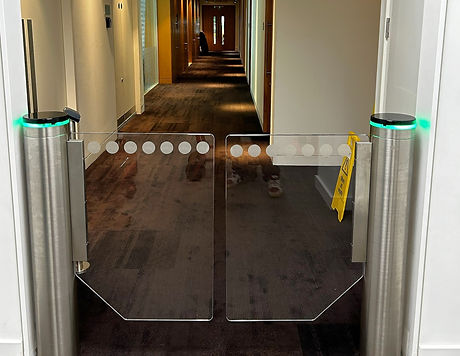
Swing gates, often referred to as pass gates, are motorised pedestrian entrance control systems designed to provide wide, accessible passageways for wheelchair users, people with reduced mobility, parents with pushchairs, and users transporting large or bulky items.
Unlike speed gates or retractable barrier systems, swing gates use a single glass, acrylic, or metal arm that pivots open through approximately 90° when an authorised access request is received.
Once a user presents valid credentials, such as an RFID card, QR code, mobile credential, fingerprint, or facial recognition the access control system signals the gate to open, providing a wide, unobstructed passage.
Depending on the model, the gate is monitored by one or two infrared safety beams or a microwave presence sensor to detect when the passage is occupied.
Once the user has safely passed through, the barrier automatically returns to the closed position. Safety features help prevent the gate from closing while the passage is in use.
Swing gates are commonly installed alongside tripod turnstiles, speed gates, or retractable flap gates to provide an accessible ADA/DDA-compliant lane.
Applications
Swing gates are designed to provide accessible, controlled pedestrian access accommodating wheelchair users, mobility scooters, pushchairs, delivery trolleys, luggage, bicycles, and other oversized items that cannot comfortably pass through a standard pedestrian lane.
They are commonly installed as an ADA/DDA-compliant access lane alongside speed gates, tripod turnstiles, or flap gates, ensuring all users can enter safely and comfortably.
Typical applications include:
-
Corporate Offices & Headquarters – Provide an accessible entrance for wheelchair users, visitors, and staff carrying large items while complementing the main entrance control system.
-
Commercial Buildings & Business Parks – Create a dedicated accessible lane alongside speed gates or turnstiles for visitors, deliveries, and building occupants.
-
Education Campuses – Accommodate wheelchair users, maintenance equipment, trolleys, and deliveries while maintaining controlled access.
-
Healthcare Facilities – Provide barrier-free access for wheelchairs, mobility scooters, hospital beds, and medical equipment.
-
Transportation Hubs – Allow passengers with luggage, bicycles, prams, or reduced mobility to pass through a wider access lane.
-
Leisure & Fitness Centres – Enable easy access for wheelchair users, families with pushchairs, and members carrying sports equipment.
-
Visitor Attractions – Facilitate the movement of visitors with pushchairs, wheelchairs, luggage, or oversized items while maintaining controlled entry.
-
Industrial & Manufacturing Facilities – Allow staff and contractors to move equipment, trolleys, and deliveries through secure access points.
-
Retail & Public Buildings – Provide an accessible entrance for all visitors while complying with accessibility regulations and maintaining secure pedestrian management.
Advantages
Swing gates provide a practical and accessible entrance control solution, making them an ideal complement to turnstiles and speed gates where a wider passage is required.
-
Accessible Passage – Provides a wide, unobstructed lane for wheelchair users, people with reduced mobility, parents with pushchairs, and users carrying large or bulky items.
-
ADA/DDA Compliant – Helps organisations meet accessibility requirements by providing an inclusive access route alongside standard pedestrian lanes.
-
Versatile Integration – Can operate as a standalone access gate or alongside tripod turnstiles, speed gates, retractable flap gates, and full-height turnstiles to create a complete entrance control solution.
-
Wide Passage Widths – Available in a range of passage widths to accommodate wheelchairs, mobility scooters, delivery trolleys, bicycles, luggage, and maintenance equipment.
-
Access Control Integration – Compatible with RFID card readers, QR code readers, biometric devices, facial recognition systems, mobile credentials, and other third-party access control technologies.
-
Low Impact Force – The motorised barrier is designed to operate with a low closing force, reducing the risk of injury while providing safe and reliable pedestrian access.
-
Quiet, Smooth Operation – Provides controlled, low-noise operation, making swing gates suitable for offices, healthcare facilities, education campuses, and other indoor environments.
-
Low Maintenance – With a simple pivoting mechanism and relatively few moving parts, swing gates offer reliable performance with minimal routine maintenance.
-
Flexible Arm Options – Available with glass, acrylic, or metal arms in a range of heights and finishes to suit different applications and architectural styles.
-
Indoor Applications – Designed primarily for indoor installations.
Disadvantages
While swing gates provide an excellent accessible access solution, there are several factors to consider when specifying them:
-
Lower Security – Swing gates are designed to provide accessible access rather than a high level of physical security. They offer less deterrence against unauthorised entry than speed gates or full-height turnstiles.
-
Lower Throughput – Typically designed for occasional or controlled use, swing gates process fewer users per minute than dedicated speed gates or turnstiles.
-
Wider Installation Space – The swinging barrier requires sufficient clearance to open, making swing gates unsuitable for narrow corridors or confined entrances.
-
Potential for Misuse – The wider passage can make it easier for multiple people to attempt entry on a single authorisation if the gate is not monitored or integrated with additional detection devices.
-
Indoor Use Only – Most swing gates are designed for indoor environments and are not intended for exposed external installations.
-
Limited Detection – Compared with speed gates, swing gates generally use fewer safety and detection sensors, providing simpler functionality with less sophisticated tailgating detection.
-
Not Suitable for High-Security Areas – Where anti-tailgating, high-security monitoring, or strict one-person-per-passage control is required, speed gates or security portals are often a more appropriate solution.
Outdoor speed gates are weather-resistant motorised pedestrian entrance control systems designed to provide secure access in exposed environments.
They are constructed using durable, weather-resistant materials and components to withstand outdoor conditions such as rain, dust, temperature changes, and wind.
Unlike indoor speed gates, outdoor models typically use metal or perforated acrylic arm. The mesh-style design allows wind to pass through the barrier, reducing wind resistance and preventing excessive forces from affecting the movement of the arms during operation.
Once a user presents valid credentials, such as an RFID card, QR code, mobile credential, biometric authentication, or facial recognition the access control system signals the gate to allow access.
Safety sensors monitor the passage area to help ensure safe operation and confirm that the user has passed through before the barriers return to the closed position.
Depending on the system configuration, additional security features can include tailgating detection, alarm outputs, and integration with wider security management systems.
Designed specifically for external applications, outdoor speed gates provide reliable pedestrian control where durability, security, and environmental performance are essential.
Applications
Outdoor speed gates are suitable for external pedestrian entrances and semi-exposed areas where controlled access, durability, and reliable operation are required.
Typical applications include:
-
Corporate Campuses & Office Developments – Secure outdoor employee entrances and manage pedestrian access before reaching the main building.
-
Industrial Facilities & Manufacturing Sites – Control staff and contractor access at factory entrances, warehouses, and production facilities.
-
Data Centres & Critical Infrastructure – Protect secure perimeter entrances with integrated access control and monitoring.
-
Transportation Facilities – Manage staff and passenger access at airports, railway stations, ports, and transport terminals.
-
Education Campuses – Control access at external entrances to schools, colleges, and universities.
-
Sports Venues & Stadiums – Manage high volumes of visitors and staff entering outdoor areas.
-
Leisure Facilities & Visitor Attractions – Provide controlled entry at theme parks, zoos, museums, and outdoor entertainment venues.
-
Government & Security Facilities – Secure external pedestrian access points where controlled entry is required.
-
Residential Developments – Provide secure access to apartment complexes, gated communities, and shared outdoor areas.
-
Utilities & Energy Sites – Protect external pedestrian access points at power stations, water facilities, and renewable energy sites.

Advantages
Swing gates provide a practical and accessible entrance control solution, making them an ideal complement to turnstiles and speed gates where a wider passage is required.
-
Accessible Passage – Provides a wide, unobstructed lane for wheelchair users, people with reduced mobility, parents with pushchairs, and users carrying large or bulky items.
-
ADA/DDA Compliant – Helps organisations meet accessibility requirements by providing an inclusive access route alongside standard pedestrian lanes.
-
Versatile Integration – Can operate as a standalone access gate or alongside tripod turnstiles, speed gates, retractable flap gates, and full-height turnstiles to create a complete entrance control solution.
-
Wide Passage Widths – Available in a range of passage widths to accommodate wheelchairs, mobility scooters, delivery trolleys, bicycles, luggage, and maintenance equipment.
-
Access Control Integration – Compatible with RFID card readers, QR code readers, biometric devices, facial recognition systems, mobile credentials, and other third-party access control technologies.
-
Low Impact Force – The motorised barrier is designed to operate with a low closing force, reducing the risk of injury while providing safe and reliable pedestrian access.
-
Quiet, Smooth Operation – Provides controlled, low-noise operation, making swing gates suitable for offices, healthcare facilities, education campuses, and other indoor environments.
-
Low Maintenance – With a simple pivoting mechanism and relatively few moving parts, swing gates offer reliable performance with minimal routine maintenance.
-
Flexible Arm Options – Available with glass, acrylic, or metal arms in a range of heights and finishes to suit different applications and architectural styles.
-
Indoor Applications – Designed primarily for indoor installations.
Disadvantages
While swing gates provide an excellent accessible access solution, there are several factors to consider when specifying them:
-
Lower Security – Swing gates are designed to provide accessible access rather than a high level of physical security. They offer less deterrence against unauthorised entry than speed gates or full-height turnstiles.
-
Lower Throughput – Typically designed for occasional or controlled use, swing gates process fewer users per minute than dedicated speed gates or turnstiles.
-
Wider Installation Space – The swinging barrier requires sufficient clearance to open, making swing gates unsuitable for narrow corridors or confined entrances.
-
Potential for Misuse – The wider passage can make it easier for multiple people to attempt entry on a single authorisation if the gate is not monitored or integrated with additional detection devices.
-
Indoor Use Only – Most swing gates are designed for indoor environments and are not intended for exposed external installations.
-
Limited Detection – Compared with speed gates, swing gates generally use fewer safety and detection sensors, providing simpler functionality with less sophisticated tailgating detection.
-
Not Suitable for High-Security Areas – Where anti-tailgating, high-security monitoring, or strict one-person-per-passage control is required, speed gates or security portals are often a more appropriate solution.
Not sure if the PG127 is the right solution?
Compare the PG127 with the PG150, PG300 and RG Series, or speak to one of our entrance control specialists for independent advice.
3. Compare it with the rest of the range
This is probably the biggest missed opportunity.
Many buyers won't know the difference between a PG127 and a PG300.
A simple comparison table would help:
2. Add a "Best suited for" section
Right below the hero, include a row of icons or badges:
Ideal For
-
🏢 Corporate Offices
-
🏨 Hotels
-
🎓 Education
-
💪 Leisure & Fitness
-
🏥 Healthcare
-
🏢 Commercial Buildings
Visitors often want reassurance that they're looking at the right product.
Choose Your Application.
Commercial & Industrial.
-
Commercial Office Buildings.
-
Warehouses, Logistics & Distribution Centres.
-
Manufacturing & Industrial Facilities.
-
Data Centres.
-
Building & Construction Sites.
Government & Public Sector Facilities.
-
Executive Agency - DVLA, HM Prison and Probation Service, Met Office.
-
Departmental Public Body (NDPB) - British Council, Environment Agency, Health and Safety Executive.
-
Ministerial Department (NMD) - Food Standards Agency, HM Revenue & Customs, Ofgem.
-
Government Buildings - Local Authority Office, Council Offices & Town Halls, Civic Buildings.
-
Government Amenities - Public Toilets, Libraries, Community Hubs.
-
Education - Schools, Collages, Universities, Academies, Research Campuses.
-
Emergancy Services - Police Stations, Fire & Rescue Services, Ambulance Service Facilities.
-
Healthcare - Hospitals, NHS Facilities, Private Healthcare Centres.

Leisure & Entertainment
-
Sports Venues & Stadiums.
-
Well-being, Leisure Centres & Gyms.
-
Visitor Attractions, Theme Parks & Zoos.
-
Museums & Galleries.
-
Theatres & Entertainment Venues.
-
Arenas & Event Spaces.
Step 3 – Product Selector.
Not sure if the PG127 is the right solution?
Compare the PG127 with the PG150, PG300 and RG Series, or speak to one of our entrance control specialists for independent advice.
3. Compare it with the rest of the range
This is probably the biggest missed opportunity.
Many buyers won't know the difference between a PG127 and a PG300.
A simple comparison table would help:
2. Add a "Best suited for" section
Right below the hero, include a row of icons or badges:
Ideal For
-
🏢 Corporate Offices
-
🏨 Hotels
-
🎓 Education
-
💪 Leisure & Fitness
-
🏥 Healthcare
-
🏢 Commercial Buildings
Visitors often want reassurance that they're looking at the right product.
Step 4 – Compare Features
Rather than long paragraphs... FeatureTripodPaddleSpeedSwingFull Height Anti-tailgating✓✓✓✓✓✓✓ RFID✓✓✓✓✓ Facial Recognition✓✓✓✓✓ QR Code✓✓✓✓✓ Outdoor✓Optional—✓✓ Emergency Release✓✓✓✓✓
Step 5 – Typical Applications.
Not sure if the PG127 is the right solution?
Compare the PG127 with the PG150, PG300 and RG Series, or speak to one of our entrance control specialists for independent advice.
3. Compare it with the rest of the range
This is probably the biggest missed opportunity.
Many buyers won't know the difference between a PG127 and a PG300.
A simple comparison table would help:
2. Add a "Best suited for" section
Right below the hero, include a row of icons or badges:
Ideal For
-
🏢 Corporate Offices
-
🏨 Hotels
-
🎓 Education
-
💪 Leisure & Fitness
-
🏥 Healthcare
-
🏢 Commercial Buildings
Visitors often want reassurance that they're looking at the right product.


Step 6 – Which Product Fits Your Budget?
Not sure if the PG127 is the right solution?
Compare the PG127 with the PG150, PG300 and RG Series, or speak to one of our entrance control specialists for independent advice.
3. Compare it with the rest of the range
This is probably the biggest missed opportunity.
Many buyers won't know the difference between a PG127 and a PG300.
A simple comparison table would help:
2. Add a "Best suited for" section
Right below the hero, include a row of icons or badges:
Ideal For
-
🏢 Corporate Offices
-
🏨 Hotels
-
🎓 Education
-
💪 Leisure & Fitness
-
🏥 Healthcare
-
🏢 Commercial Buildings
Visitors often want reassurance that they're looking at the right product.
Step 7 – Why Choose Evolve?
Not sure if the PG127 is the right solution?
Compare the PG127 with the PG150, PG300 and RG Series, or speak to one of our entrance control specialists for independent advice.
3. Compare it with the rest of the range
This is probably the biggest missed opportunity.
Many buyers won't know the difference between a PG127 and a PG300.
A simple comparison table would help:
2. Add a "Best suited for" section
Right below the hero, include a row of icons or badges:
Ideal For
-
🏢 Corporate Offices
-
🏨 Hotels
-
🎓 Education
-
💪 Leisure & Fitness
-
🏥 Healthcare
-
🏢 Commercial Buildings
Visitors often want reassurance that they're looking at the right product.
Get In Touch
One of our experts will be in touch to fully descuss your requirements.
Step 2 – Compare Products.
Not sure if the PG127 is the right solution?
Compare the PG127 with the PG150, PG300 and RG Series, or speak to one of our entrance control specialists for independent advice.
3. Compare it with the rest of the range
This is probably the biggest missed opportunity.
Many buyers won't know the difference between a PG127 and a PG300.
A simple comparison table would help:
2. Add a "Best suited for" section
Right below the hero, include a row of icons or badges:
Ideal For
-
🏢 Corporate Offices
-
🏨 Hotels
-
🎓 Education
-
💪 Leisure & Fitness
-
🏥 Healthcare
-
🏢 Commercial Buildings
Visitors often want reassurance that they're looking at the right product.


%20Evolve%20RG200.jpg)